The Personal Journey — 12 Weeks
A private somatic coaching arc designed for practitioners, change-makers, and sensitive souls navigating personal transformation. You'll develop embodied literacy — the capacity to read your body's signals, regulate your nervous system, and move from reactivity to sovereignty.
Safety & Orientation
Weeks 1–3 · Nervous System Foundation
You leave knowing how to return to yourself.
Your Body Has Always Known
Before strategy, before insight — there is the body. This first session orients you to somatic practice not as technique but as re-wilding: learning to trust the intelligence already alive in you.
We map the landscape of your nervous system — the survival circuits that fire before thought, the places where protection became prison, and the signals that already know the way through.
Jin Shin Jyutsu — Safety Hold: Place your right hand over the back of your left hand. Hold gently for 3–5 minutes. Let the warmth between your palms become its own instruction. Notice what quiets.
Opening inquiry: Where in your body do you first feel safety? Where do you first feel threat? Sit with these questions without needing answers. Let the body speak in texture, temperature, and sensation.
Mapping the Survival Nervous System
We explore the three primary states of the autonomic nervous system — ventral vagal (safe and social), sympathetic (mobilized), and dorsal vagal (collapsed) — not as clinical categories but as lived territories you already know.
Understanding which state you're in is the first act of sovereignty. You cannot choose a different response from a body you haven't learned to read.
State-Tracking Practice: Three times daily for one week, pause and locate yourself. Ask: Am I in open connection, activated urgency, or flat withdrawal? No judgment — only witnessing. Keep a one-word log.
The First Language — Sensation
Sensation is the root grammar of the body's native tongue. Tension, tingling, weight, warmth, constriction, expansion — these are not symptoms to fix but transmissions to receive.
This lesson develops somatic vocabulary: the ability to stay present with sensation long enough to hear what it is trying to protect.
EFT Tapping — Safety Sequence:
- Karate chop: "Even though I sometimes leave my body, I deeply accept myself."
- Eyebrow, side of eye, under eye, under nose, chin, collarbone, under arm — moving slowly, staying with sensation.
- Complete with both hands on heart, three slow exhales.
Module 1 Deliverable: A personal "body map" — a simple diagram or written description of where you hold safety, activation, and shutdown in your physical form. This becomes your compass orientation point.
"The body is not a problem to be solved. It is a territory to be befriended, an oracle to be listened to, a revolution that begins in the cells."— Resonance Tunes
Energy & Meaning
Weeks 4–6 · Life Force and the Stories We Tell
You leave with a renegotiated relationship to your own aliveness.
Circuit Two — The Emotional Body
In the 8-Circuit model of consciousness, the second circuit governs emotional intelligence, belonging, and the deeply territorial sense of safety-in-relationship. This is where many of us carry our oldest wounds: the places where love came conditional, where belonging required self-erasure.
We work here not to analyze these patterns but to metabolize them — to create enough somatic safety that the old contractions can finally complete their interrupted movements.
TRE — Trauma Release Exercises: Begin lying on your back, knees bent. Gently walk your feet out until tremoring begins spontaneously. Allow the body's natural tremor mechanism to activate without directing it. Continue for 10–15 minutes. Rest for 5 minutes before rising.
Inquiry: Where in your life did you learn that your feelings were too much, too loud, too tender? Where did you begin contracting around your own aliveness to feel accepted? Let these questions live in the body, not just the mind.
The Chakra System as Somatic Map
The chakra system is not metaphor but functional anatomy of consciousness — each energy center corresponding to a developmental stage, a layer of selfhood, a domain of life force. We move through the first four centers, each connected to foundational affirmations that rewire neural pathways:
Root to Heart — Chakra Affirmation Sequence:
- I Am — (Root/Muladhara) Place hands on thighs. Feel the earth beneath you. Repeat 7 times with breath.
- I Feel — (Sacral/Svadhisthana) Hands on lower belly. Acknowledge your emotional reality without story. 7 repetitions.
- I Do — (Solar Plexus/Manipura) Hands on ribcage. Sense your agency, your fire. 7 repetitions.
- I Love — (Heart/Anahata) Hands on chest. Allow warmth. 7 repetitions.
The Stories the Body Carries
Every chronic tension pattern is a narrative encoded in tissue. The locked jaw that never learned to say "no." The sunken chest that once made itself small to keep the peace. The braced belly holding ancient grief.
In this session, we use guided visualization and Qi Gong movement to begin unbinding these narratives — not through analysis, but through movement that completes what was frozen.
Qi Gong — Shaking Heaven and Earth: Stand with feet hip-width apart, knees soft. Begin with gentle microbends in the knees, letting the movement travel up through the spine. Gradually increase amplitude. Allow the arms to swing loosely. Continue for 5 minutes. Finish by standing still and receiving the stillness.
Writing practice: "The story my body has been telling is___." Write for 15 minutes without stopping. Don't edit. Let the body write through you.
Module 2 Deliverable: A "narrative map" — the three central stories your body has been holding (in tension, posture, or pattern) and the first breath of a different possibility for each.

Expression & Action
Weeks 7–9 · Voice, Boundary, and Embodied Power
You leave able to speak from your body, not just your mind.
The Throat as Gateway
The fifth chakra — Vishuddha, "the purifier" — is where truth must become sound to become real. How many of us live our entire lives holding back the words our bodies already know? The tight throat, the swallowed protest, the permission you were never given to simply say what is true.
We work here with solfeggio frequency 741 Hz — the tone associated with awakening intuition and dissolving the blocks that silence authentic expression.
Throat Opening Sequence:
- Begin with lion's breath — 5 repetitions (wide eyes, extended tongue, full exhale roar).
- Hum for 2 minutes on a single sustained note, feeling the vibration in your sternum.
- Speak one true sentence out loud that you've been withholding. Don't explain it. Just say it.
- Finish with a hand on the throat, 3 slow breaths.
Inquiry: What have you been waiting for permission to say? What would you speak if you knew your words would land safely? Let your hand rest on your throat as you sit with this.
The Embodied "No" — Boundaries as Sacred Architecture
A boundary is not a wall — it is a membrane. A living, breathing delineation of where you end and another begins. Without it, the energy that should power your own becoming leaks endlessly into managing others' discomfort.
In this session, we practice finding the boundary in the body before speaking it — the felt sense of "no" as a somatic event, not a cognitive decision.
Kundalini Breathwork — Breath of Fire with Intention: Rapid, equal inhale/exhale through the nose, driven by the navel center. Begin with 1 minute, working up to 3. Hold at the peak, drawing energy upward through the spine. Release fully. In the stillness, locate your inner "yes" and your inner "no" as distinct somatic sensations.
Forgiveness as Somatic Release
Forgiveness is frequently misunderstood as spiritual bypassing — a way of making peace with what should have never been. Somatic forgiveness is something else entirely: the act of releasing your body from carrying what was never yours to hold.
This practice draws on HeartMath coherence techniques and guided visualization to create the physiological shift that makes genuine forgiveness possible.
HeartMath Coherence Practice:
- Heart-focused breathing: breathe as if the breath enters and exits through the heart center, slightly slower and deeper than normal. 5–10 minutes.
- Generate a genuine feeling of appreciation or care — a person, a moment, a place. Let the feeling build without effort.
- From this state of coherence, invite the person or situation requiring forgiveness. Notice what has shifted in your body's capacity to hold them.
Module 3 Deliverable: A spoken-word or written "declaration of expression" — three truths you have begun to speak from your body, and the body sensations that arise when you speak each one clearly and unapologetically.
Integration & Emergence
Weeks 10–12 · Sovereignty, Vision, and New Architecture
You leave as the author of your next chapter.
The Heroine's Descent
Every true transformation requires a descent — a journey into the depths where the old structures dissolve and the new possibility can form. This is not pathology; it is the structural requirement of becoming.
We work with the Heroine's Journey (Vasilisa and Baba Yaga) as a mythic map for your personal arc — identifying which of the 9 tasks you have moved through, and what the dark forest is asking of you now.
Guided Visualization — Meeting Your Inner Knowing: 20-minute practice. You will be led through a threshold into an inner landscape to meet the part of you that already knows the way through. Have a journal ready for immediate writing afterward.
Mythic inquiry: Which moment in your life required you to enter the dark forest? What did you have to surrender to pass through? What did you bring back? How is that wisdom being asked to serve others now?
The Consciousness Map — Where You Are on the Spiral
Spiral Dynamics offers a developmental map — not a hierarchy of worth but a map of meaning-making. Understanding your own center of gravity on this spiral allows you to see where your edges are, what you're integrating, and where the next layer of growth is already pulling you.
| Level | Core Theme | Shadow to Integrate |
|---|---|---|
| Purple | Ancestral safety, belonging, ritual | Superstition, clinging, exclusion of outsiders |
| Red | Personal power, immediacy, vitality | Domination, impulsivity, exploiting others |
| Blue | Order, purpose, sacrifice for meaning | Rigidity, judgment, fundamentalism |
| Orange | Achievement, strategy, autonomy | Competition, materialism, relativity |
| Green | Community, care, egalitarian values | Relativism, process paralysis, anti-hierarchy |
| Yellow | Systemic thinking, functional flow | Cold analysis, disconnection from community |
| Turquoise | Holistic integration, planetary consciousness | Loss of practical grounding |
The Architecture of Your Next Chapter
Integration is not a destination — it is a practice of continual becoming. In this closing session, we design the architecture of your life forward: the practices that become daily, the edges that become invitations, the ways your own healed aliveness becomes available as service.
Pranic Healing — Self-Sweep: Using intentional breath and slow hand movements 4–6 inches from the body, sweep energy from the crown down through the aura to the feet. Visualize releasing what has been composted through this work. Three complete passes. Finish with a physical seal — hands crossed over heart, full breath, intentional release.
Closing questions:
- What has changed in how you inhabit your body?
- What practice will you carry forward as non-negotiable?
- Who in your life is being changed by your healing?
- What are you now ready to build?
Final Individual Deliverable: Your Personal Somatic Charter — a 1–2 page living document describing your nervous system landscape, your core practices, your edges of growth, and your declaration of what you are building from this foundation. This becomes your compass going forward.
The Collective Arc — 8–10 Weeks
A team and organizational journey designed for DEI practitioners, conscious organizations, and communities of practice. This arc moves teams through honest diagnosis, somatic repair, regenerative culture design, and evolutionary capacity building.
Diversity, Equity, Inclusion & Belonging
In the Workplace & Everyday Life
The frameworks, practices, and field-tested protocols in this collective track draw directly from Sahar's published work — including the Alchemy of Apology model, silencing tactic recognition, trauma-informed repair, and regenerative culture design.
System Diagnosis
Weeks 1–2 · Reading the Body of the Organization
Your team leaves with a shared language for what is actually happening here.
The Organization as Living System
Organizations are not machines — they are living bodies with their own nervous systems, traumas, and adaptive patterns. Before any change work can land, the system must be able to see itself clearly: the survival patterns masquerading as culture, the wounds encoded in policies, the brilliance that's been suppressed by fear.
We begin with a full somatic system audit — reading energy, power, safety, and belonging across the organizational body.
Diagnostic Tool — 4-Domain Scan: Each participant rates their experience in four domains (Safety / Belonging / Voice / Agency) on a scale of 1–10, accompanied by one body sensation they notice when thinking about each domain. Results are mapped collectively — patterns emerge without attribution.
Facilitator Note: The anonymized somatic scan often reveals systemic patterns that survey data misses — particularly the gap between stated values and embodied reality. Common finding: high "belonging" scores accompanied by chest tightness and held breath = belonging conditional on performance.
Facilitated session demonstrating the full diagnostic process with a real team.
Suggested clip: 0:00–3:45 (opening somatic check-in) + 12:00–18:30 (pattern mapping)
Power Mapping and Invisible Architecture
Every organization has an official structure and a shadow structure — the real flows of power, belonging, and decision-making that operate beneath the org chart. Making these visible is not an act of accusation but of honest witnessing: the prerequisite for transformation.
Using the Spiral Dynamics framework as a lens, we map where different parts of the organization are operating — and where the mismatches creating friction actually live.
Values Archaeology — Group Exercise:
- Teams map their top 5 stated organizational values.
- Each team member identifies one concrete recent decision that honored the value — and one that violated it.
- Patterns are named in the collective without blame. The question is always: What does this pattern serve? What survival need does it meet?
7 Failure Modes
The seven most common failure patterns in organizations — each with a systemic description, the warning signs that appear before the failure, and a structural intervention. Use as a diagnostic lens against your current org context.
Use in Session 1.2 after power mapping. Each person identifies which failure mode most resonates with their team's current dynamic, then compares in small groups.
7 Failure Modes — diagnostic reference for identifying systemic risk patterns.
Open Tool →Inclusion & Repair
Weeks 3–5 · Accountability, Microaggressions, Conversational Repair
Your team leaves with practical protocols for navigating harm and restoring trust.
Understanding Microaggressions as Somatic Events
Microaggressions are not just linguistic incidents — they are somatic interruptions. The body of the person who receives one often knows before the mind processes what has happened: the slight contraction in the chest, the heat in the face, the sudden need to make oneself smaller or to fight.
In this session, we build a shared vocabulary for what happens in the body during these interactions — for both the person experiencing harm and the person who caused it — and why physiological understanding changes the capacity for repair.
Somatic Accountability Protocol:
- Pause: When you notice impact, call a somatic pause. "I notice I'm having a reaction — can we slow down?"
- Locate: Each person identifies where in their body they are experiencing this moment. Share with specificity, not story.
- Receive: The person who caused harm receives the impact without defending. The goal is to let the impact land.
- Repair: A specific, embodied acknowledgment — not "I'm sorry if you were hurt" but "I can feel that what I said landed as ___. That is not what I intended, and I understand the impact is what matters."
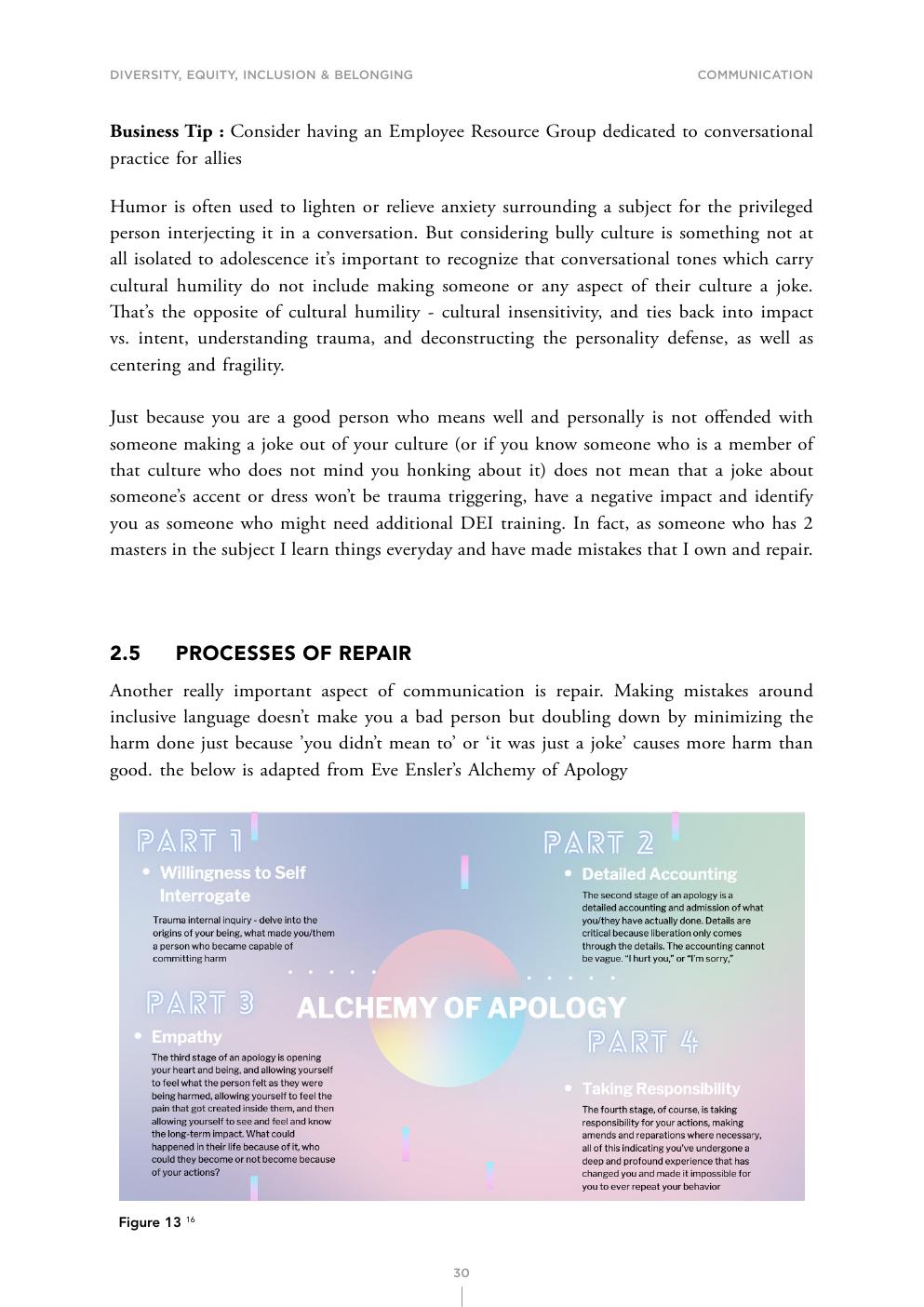
The Alchemy of Apology
True repair is not a single gesture — it is a four-phase process that moves from honest self-confrontation to embodied accountability. This framework, developed through Sahar's direct field work in organizations, gives teams a shared map for navigating genuine repair after harm.
Self-Interrogate
Before any apology can be offered, the person who caused harm must turn honestly toward themselves: What did I actually do? What assumptions, fears, or biases drove that action? What patterns in me made this possible?
Detailed Accounting
Name what happened with specificity and without minimizing. Not "I'm sorry you felt hurt" but a clear account of the action, its impact, and full ownership of the gap between intention and effect.
Empathy
Offer genuine empathic presence — an acknowledgment of how the impact felt in the other person's body and reality, without centering your own discomfort or need for forgiveness. Let their experience matter more than your relief.
Taking Responsibility
Articulate the concrete change: what you will do differently, what accountability structure you accept, and how you intend to honor the repair over time — not as a single event but as an ongoing practice.
Recognizing Silencing Tactics
Genuine repair is often blocked — not by ill will but by automatic defensive responses that organizations have normalized. Naming these patterns is not accusation; it is collective literacy. When teams can recognize these moves as they happen, the pathway to real accountability opens.
Shifting focus from the content of a concern to how it was expressed — "You'd be taken more seriously if you said it differently."
Introducing tangential issues to avoid addressing the original harm — "But what about…" or "This isn't the right time."
Centering the perpetrator's emotional distress so the harmed person becomes the comforter, and the harm itself disappears from the conversation.
Challenging someone's direct experience of harm — "That never happened," "You're being too sensitive," or "That's not what I meant."
Using visible distress (tears, shutdown, defensiveness) to make accountability conversations feel dangerous, shifting group energy toward protection rather than repair.
Equating unequal experiences to neutralize the claim — treating systemic harm as a "both sides" issue that requires no specific accountability.
The 8-Circuit Model — Where Your Team is Operating
Different challenges in an organization activate different circuits of the nervous system. Understanding which circuits are online — and which are offline — reframes many persistent team dynamics from "personality conflicts" to nervous system responses to perceived threat.
| Circuit | Domain | When Activated in Teams |
|---|---|---|
| 1 | Physical safety / survival | Job insecurity, physical environment, crisis response |
| 2 | Emotional / belonging | Relational ruptures, exclusion, belonging threats |
| 3 | Meaning-making / symbolic | Mission drift, values violations, narrative collapse |
| 4 | Social game / role | Power struggles, status, political dynamics |
| 5 | Neurosomatic / flow | Creative blocks, innovation resistance, rigidity |
| 6 | Neuroelectric / metamorphosis | Paradigm shifts, radical change moments |
Forgiveness and Repair in Systems
Organizational harm is not healed by policy revision alone — it requires the somatic completion of interrupted repair cycles. When harm is acknowledged but the physiological charge never releases, it circulates underground, emerging as chronic mistrust, diminished creativity, and high turnover.
This session adapts the individual HeartMath coherence protocol for group practice — creating the physiological conditions for genuine reconciliation.
Group Coherence Practice: Facilitated 20-minute process. Each participant independently generates heart coherence (heart-focused breathing + appreciative emotion). From this shared state, the group holds the specific injury that needs tending — no speech required. The practice is the repair.
Post-Session Integration: Following group coherence work, small groups of 3 name one concrete practice change they are willing to implement. Changes must be behavioral and specific — not "be more inclusive" but "I will explicitly invite ___'s perspective before decisions are made in our team meetings."
Communication Compass
Identify communication patterns — colourblindness, tone policing, centering, tokenising, and five more — through scenario-based reflection. One scenario at a time. Each answer reveals the pattern and a specific repair cue.
Use as a warm-up before Session 2.1, or as a take-home reflection between sessions. Individual completion, group debrief.
Communication Compass — 8 patterns, unlimited scenarios, repair language for each.
Open Tool →Conversational Repair Protocols
The 6-step repair sequence for when communication causes harm — plus the 5 things never to say. A live interactive reference to use before, during, or after a difficult conversation.
Pair with Session 2.1. Individuals work through the tool privately, then bring their reflections to group discussion. The "5 Faux Pas" tab is especially useful for team debrief.
Conversational Repair — 6-step sequence + 5 faux pas, with somatic practices for each step.
Open Tool →Regenerative Community
Weeks 6–8 · Systems Design, Belonging Architecture
Your team leaves with a working prototype of the culture you actually want.
Designing for Belonging — Not Comfort
There is a crucial distinction between environments designed for comfort — where everyone feels the same, no one is challenged, no growth is required — and environments designed for belonging — where difference is welcomed, challenge is offered with care, and each person is invited into their fullest expression.
Comfort cultures often masquerade as inclusive. The somatic marker of belonging (versus comfort) is that belonging allows discomfort to exist alongside safety — you can be challenged and still feel held.
Culture Architecture Workshop (3-hour facilitated):
- Map current culture across 5 dimensions: Psychological Safety / Power Distribution / Conflict Protocol / Decision-Making / Recognition systems.
- Identify the gap between "comfort culture" and "belonging culture" in each dimension.
- Design 1–2 concrete structural changes in each dimension that move toward belonging.
Live facilitation of the culture architecture workshop with a real organization team.
Suggested clip: 0:00–4:00 (framing belonging vs. comfort) + 28:00–35:00 (prototype presentations)
Rituals of Threshold — Meeting Moments That Matter
Every community is held together by its rituals: the ways it marks beginnings and endings, honors effort, acknowledges loss, and celebrates becoming. Many organizations have rituals without knowing it — the birthday email, the all-hands, the Friday Slack check-in — but few have designed them intentionally to do the relational work that ritual is actually for.
Ritual Design Lab: Small groups design three organizational rituals — one for welcoming new members (crossing threshold), one for honoring contributions and departures (completion), and one for regular somatic reconnection within the team (ongoing coherence). Each ritual must include a moment of physical presence — touch, breath, gesture, or sound.
Evolution & Emergence
Weeks 9–10 · Leadership, Sustainability, Legacy
Your organization leaves as an agent of conscious evolution — not just internally, but in the world.
Embodied Leadership — The Body in the Room
Leadership is somatic before it is strategic. The most sophisticated DEI policy can be undermined in a 3-second interaction — by who gets eye contact, whose idea gets developed, who is interrupted, who is never looked at directly. Your body is your leadership.
In this session, leaders develop their "somatic leadership audit" — the ability to read the room through the body's data and adjust in real time.
The Leadership Body Scan (practiced before every meeting):
- Arrive 2 minutes early. Feel your feet on the floor. Breathe into your belly.
- Ask: What state am I bringing into this room? Activated? Contracted? Scattered?
- 30-second regulation practice (box breath, JSJ hold, or simple body shake).
- Conscious intention: Whose voice am I not hearing? Who am I not making contact with?
The Organization's Contribution to the World
This final collective session asks the larger question: what is this organization's work in the ecology of change? Beyond revenue and KPIs, beyond diversity metrics and policy compliance — what is the consciousness this organization is contributing to the larger field?
Using the Hero's Journey as a collective mythic map, we locate the organization's own arc: the call it has answered, the threshold it has crossed, the elixir it is now available to offer the world.
Collective closing:
- What is the wound this organization is uniquely equipped to help heal?
- What does embodied equity look like in your specific context?
- Who are the people who will be changed because you did this work?
- What is the practice this organization commits to — not the policy, but the daily practice?
Final Collective Deliverable: An Organizational Somatic Charter — a 2–3 page living document describing the organization's nervous system patterns, its cultural intentions, its repair protocols, its rituals, and its declaration of contribution. This becomes the culture compass for onboarding, leadership development, and annual review.
Transformation is not an event — it is a practice. Both tracks are designed for ongoing engagement: monthly group calls, quarterly immersives, and an evolving library of practices that deepen with each returning. What you have begun here does not end when the program ends.
Practice Library & Resources
Each module is supported by a growing library of somatic practices, guided visualizations, movement sequences, journal prompts, solfeggio soundscapes, and medicine songs. The complete digital resource kit is available to enrolled participants in the member portal.